The minimum wage in 2026: what is it really worth after deductions?
The SMIG rose by about 5% in January 2026. We work out the take-home pay, set it beside inflation and the policy rate, and explain why Moroccans debate the 5,000 DH figure.
Whenever an election or a social dialogue approaches, one number comes back to the front: the minimum wage. The debate rises because the figure directly affects millions of employees and because few people know the gap between the pay written in a contract and the amount that reaches the account. So let us start with the numbers.
According to the decree published in December 2025, the hourly rate rose by about 5%, close to 3.11 DH an hour according to press reports. The monthly figure varies slightly with the basis used: 17.92 × 2,288 hours a year ÷ 12 gives 3,416.75 DH, while the common basis of 191 hours a month gives 3,422.72 DH.
What stays in your pocket?
A private-sector employee pays their share of social-security contributions and compulsory health insurance. At these pay levels there is practically no income tax, so most of the pay remains. For a basic salary of 3,500 DH the Rateb engine gives a net of 3,264 DH, meaning deductions of about 236 DH.
The gap is small at these levels because income tax is zero.
The cost to the employer exceeds the pay
Employees do not always see that employing someone costs more than what they receive: on top of gross pay the employer pays extra contributions. For a basic salary of 3,500 DH the total cost to the employer is about 4,238 DH. This is one reason why the idea of a 5,000 DH minimum wage raises questions about small businesses’ capacity.
Arguments for a 5,000 SMIG
- It directly raises the purchasing power of the lowest-paid employees.
- It narrows the gap between pay and living costs in big cities.
- It boosts domestic consumption.
Arguments for caution
- Small businesses might struggle to bear it and cut jobs or declared pay.
- The effect differs between sectors: industry, services, agriculture.
- It is better to combine pay with direct social support.
Pay and prices: the wider picture
A nominal rise means nothing if prices climb at the same pace. Fortunately inflation in Morocco is low this year: Bank Al-Maghrib’s forecasts for average 2026 range, depending on the date, between 0.7% and 1.5%, with a rise expected in 2027 as the effect of good harvests on food prices fades. The central bank kept its key rate at 2.25% at its latest meetings.
Simple arithmetic: real value = pay ÷ (1 + inflation) raised to the number of years.
The practical lesson: even with calm inflation, a wage that is not reviewed each year loses part of its value. If you are an employee, negotiate a rise that at least follows prices; if you are an employer, remember that a fair wage is a long-term investment.
From gross to netTry the private-sector calculator to see what is left after deductions.Try the calculatorSources and references
- How much the SMIG and SMAG will rise in Morocco in 2026 (Le360)
- SMIG and SMAG in Morocco 2026: official amounts (Upsilon Consulting)
- Morocco should record 1.5% inflation in 2026 (TelQuel)
- Bank Al-Maghrib keeps its key rate at 2.25% (TelQuel)
- Deduction estimates: the Rateb private-sector calculation engine
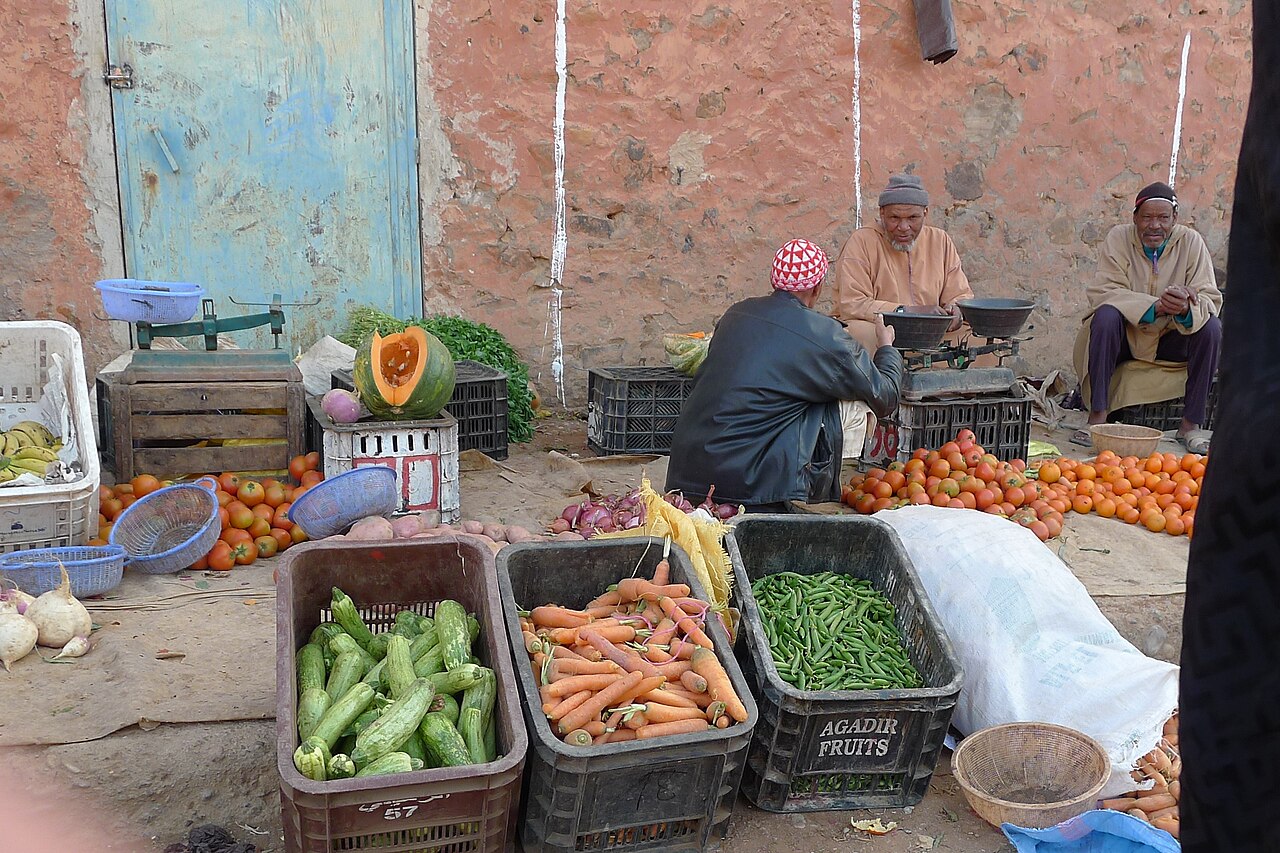
Photo: Mustang Joe, Wikimedia Commons, licence CC0.
Disclaimer: this information is educational; figures and rules can change. Always check the official source before making a financial decision.
Read next
The 50/30/20 rule in dirhams: how to split your salary without feeling deprived
A worked example on an 8,000 DH net salary, with practical steps to apply the rule in an ordinary Moroccan household: rent, family, festivals and savings.
20 November 2026 · 2 min read
How to read a pay slip: every line explained, from gross to net
Social-security contributions, health insurance and income tax explained with a worked example for a private salary of 8,000 DH. Learn each line and why it exists.
20 November 2026 · 2 min read
Inflation quietly eats your pay: what will your salary be worth in ten years?
Calm prices this year do not mean the danger has gone. A simple calculation shows what an 8,000 DH salary loses if it is never raised, and by how much pay must rise to protect purchasing power.
20 November 2026 · 2 min read